The Power of Morning Light: Your Internal Clock

How light tells your body what time it is
Before coffee, before your phone and before you consciously decide that the day has started, your body is already responding to one of the oldest signals in nature: light.
For most of human history, morning arrived gradually. Darkness softened, the sky brightened and the world around us slowly changed.
Our bodies still use that changing pattern of light and darkness as information about when to sleep and when to be awake. Light is considered the strongest environmental time cue for synchronising the human circadian system with the 24-hour day. [1]
That makes morning light much more than something that simply helps us see.
Your body has an internal clock
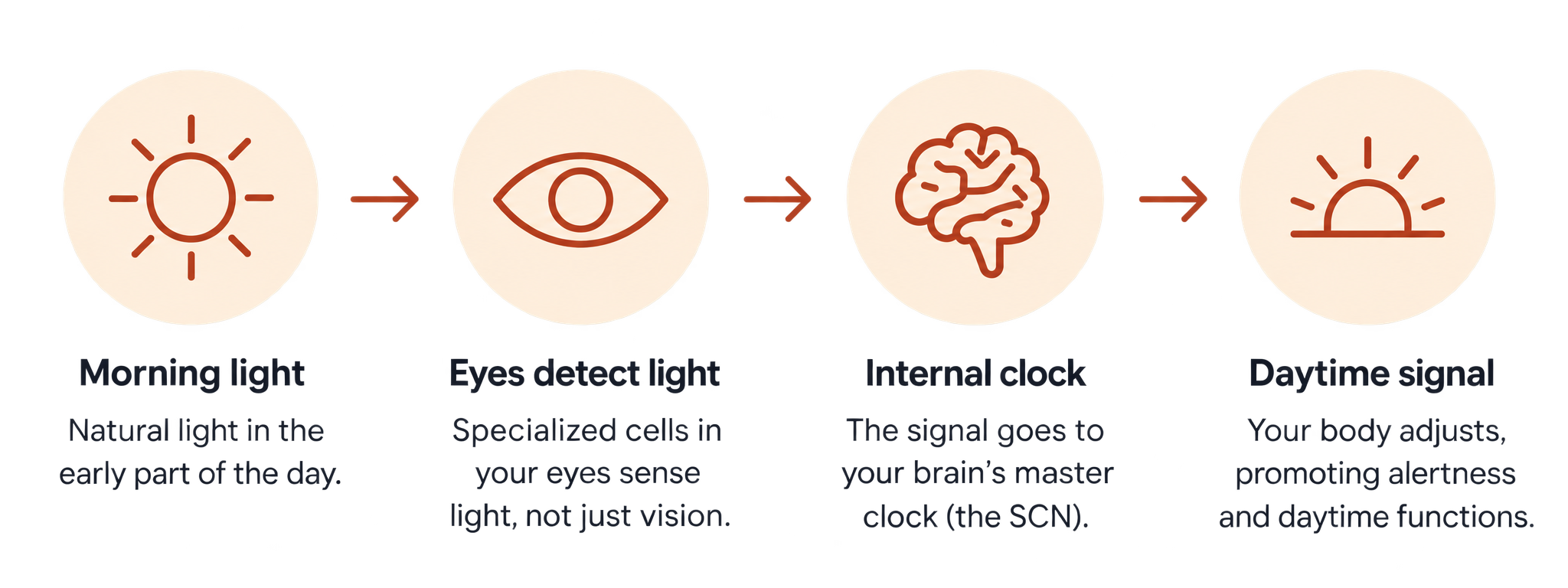
Inside the brain is a biological timing system that helps organise sleep and wakefulness across roughly 24 hours. This is part of your circadian rhythm. Your circadian system continuously receives information from the environment, and light is one of its most important signals. [1]
Specialised light-sensitive cells in the retina (eye) — known as ipRGCs — help carry information about environmental light to areas of the brain involved in circadian timing, including the body's central circadian clock. [2]
In simple terms, your eyes are doing more than creating an image of the world. They are also helping tell your brain whether it is night or day.
Why morning light matters
The biological effect of light depends strongly on when it reaches us.
Research consistently shows that light experienced during the biological morning tends to shift circadian timing earlier, while light during the biological evening and early night tends to shift it later. [3]
That does not mean a few minutes of morning light instantly “resets” your body clock. Circadian responses depend on timing, brightness, duration, spectrum, previous light exposure and individual sensitivity. But the broader principle is clear:
Our circadian system uses the daily pattern of light and darkness to understand time.
Morning light and melatonin
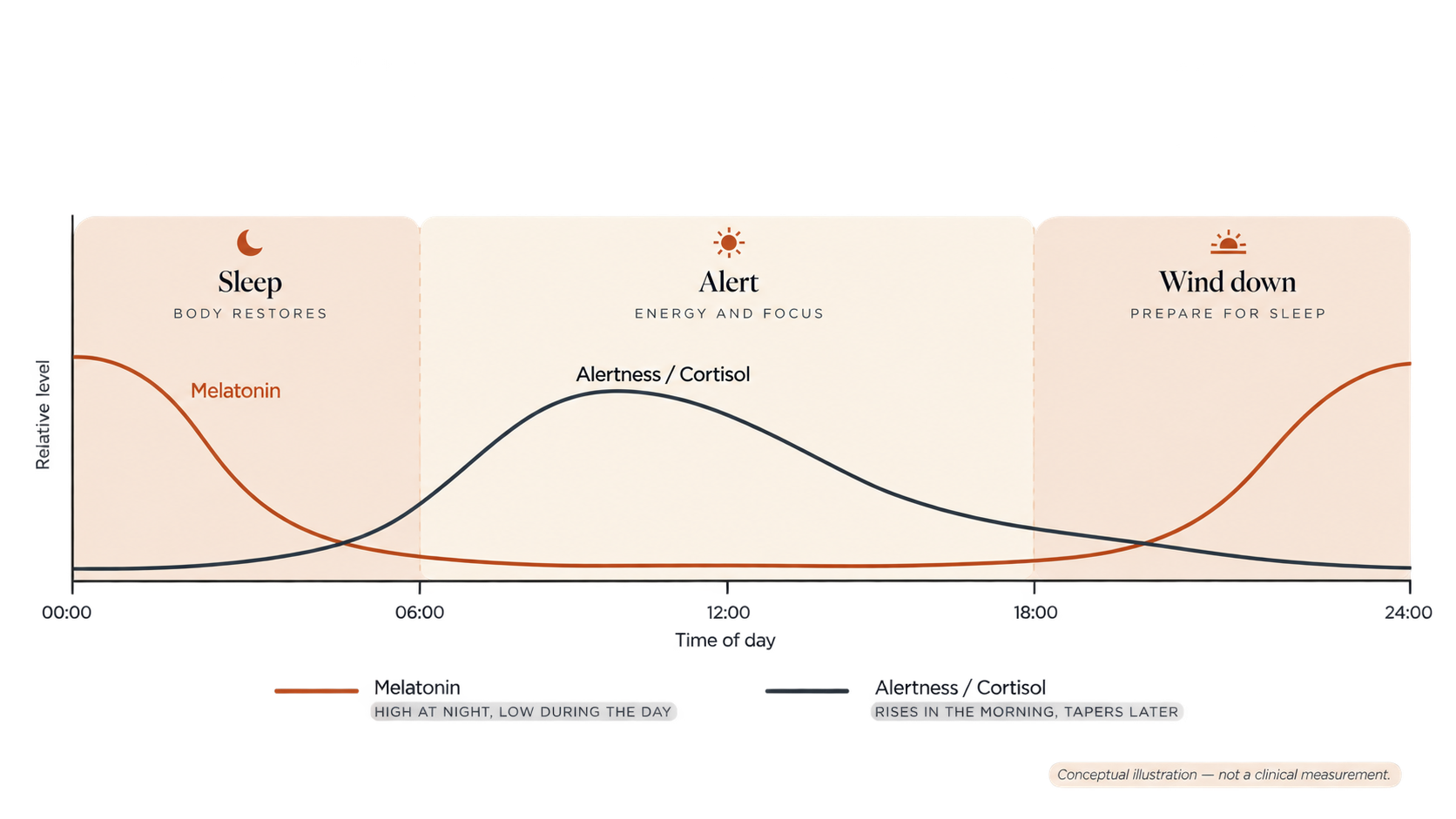
Melatonin is often called the “sleep hormone”, but it is better understood as one of the body's signals of biological night.
Its levels generally rise in the evening and remain elevated during the biological night before falling toward morning.
Light can influence melatonin and circadian timing, but the effect depends heavily on timing, intensity, duration and spectral composition. [1][3]
So saying that morning light simply “switches off melatonin” is too simplistic. The body is reading the wider pattern:
darker evening → dark night → brighter morning → bright day
Beyond Light was designed around this same principle: light can become part of the transition into morning.
By gradually increasing brightness before your chosen wake time, Beyond Light allows the room to shift gently from darkness into light — creating a softer transition into wakefulness before you open the curtains and step into natural morning light.
THE TAKEAWAY
Light is not simply illumination. Light is information.
It is one of the signals your brain uses to understand whether the world around you behaves like night or day.
Sources
[1] Chang A-M, Santhi N, St Hilaire M, et al. Human responses to bright light of different durations. The Journal of Physiology. 2012.
[2] Schmidt TM, Chen S-K, Hattar S. Intrinsically photosensitive retinal ganglion cells: many subtypes, diverse functions.Trends in Neurosciences. 2011.
[3] Duffy JF, Czeisler CA. Effect of Light on Human Circadian Physiology. Sleep Medicine Clinics. 2009.