Why Waking Up Feels Difficult

What happens in the first minutes after you open your eyes
You wake up. The alarm has stopped. Your eyes are open.
But somehow, you still do not feel fully awake.
That heavy, foggy feeling has a name: sleep inertia.
Sleep inertia is the temporary period of reduced alertness and cognitive performance that can happen immediately after waking. It is usually strongest just after waking and gradually fades as time awake increases. Its intensity and duration can vary depending on factors such as previous sleep, the time of day and how deeply you were sleeping. [1]
It is one reason waking up is not always as simple as moving instantly from asleep to awake.
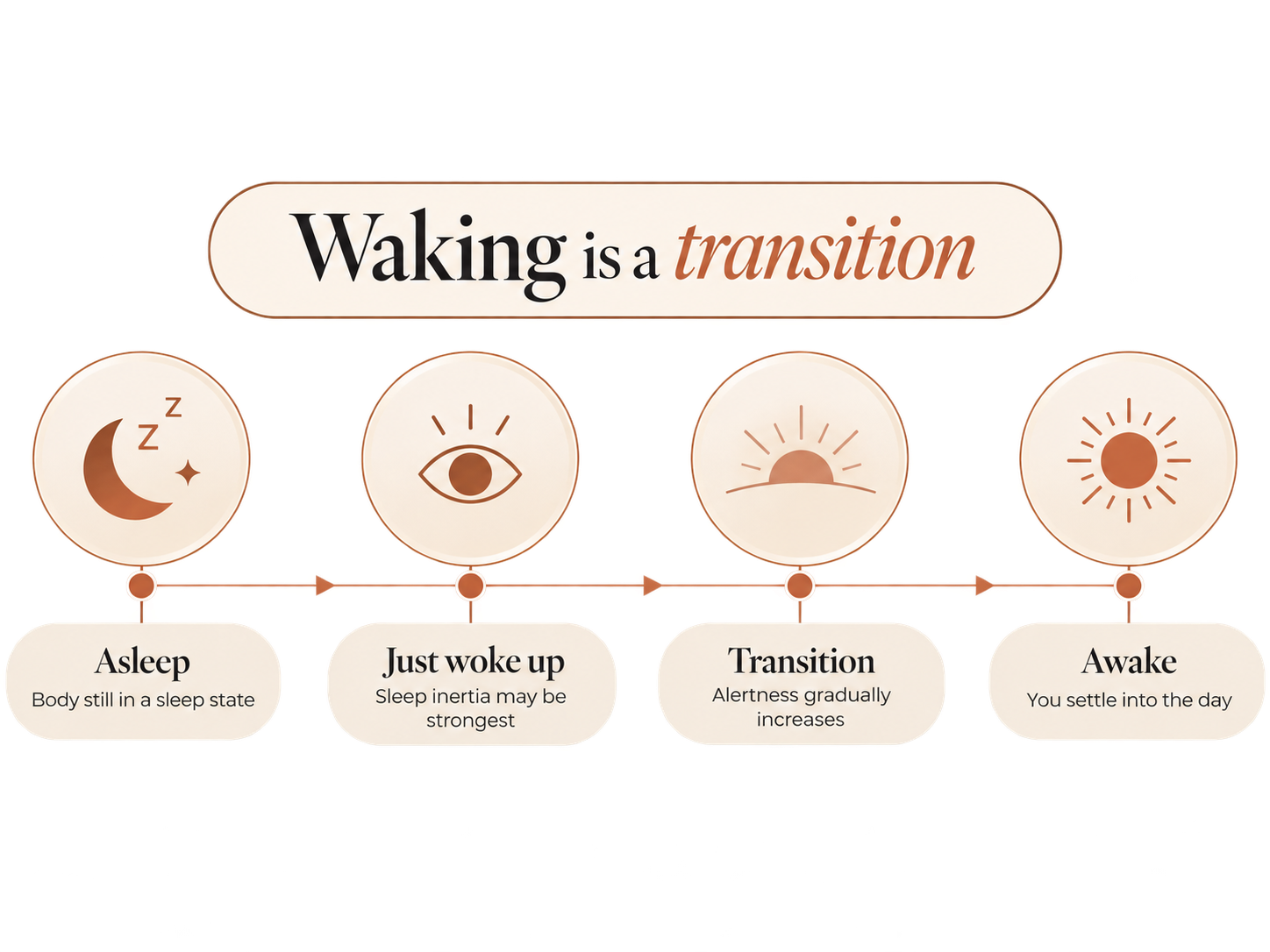
Waking is a transition
Sleep and wakefulness are not simply two switches. See conceptual visualisation ->
When you wake, different processes in the brain and body are moving from a sleeping state toward full wakefulness. During this transition, reaction time, attention and some aspects of cognitive performance can temporarily be reduced.
Sleep inertia tends to be strongest immediately after waking and usually decreases as time awake increases. It can also become more noticeable after insufficient sleep or when waking at an unfavourable point in your circadian cycle. [1]
In simple words: Your eyes can be open before your whole system feels fully awake.
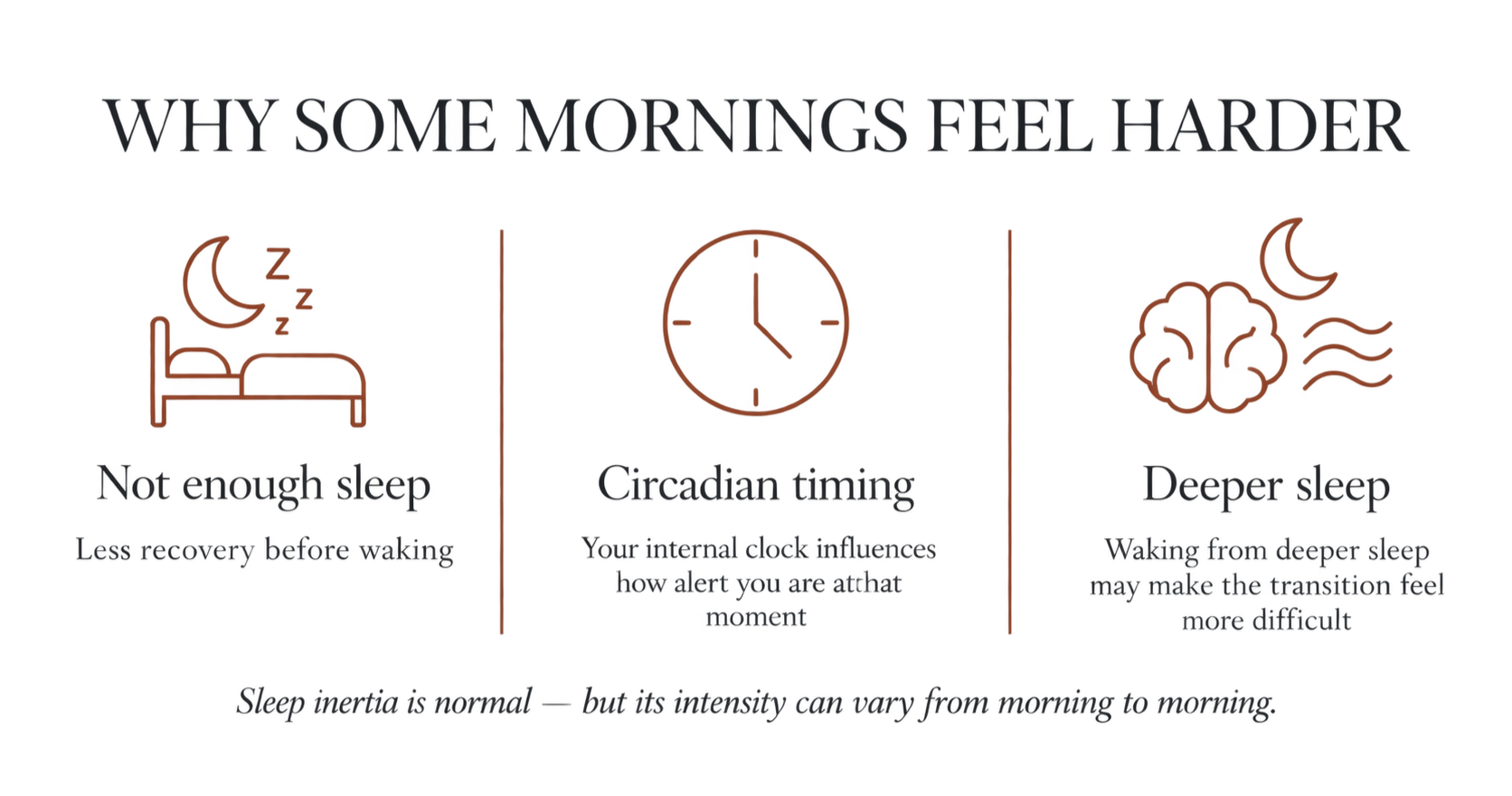
Not every morning feels the same.
Sleep inertia can be stronger when you wake after not getting enough sleep, when you wake during a biologically unfavourable time, or when waking from deeper sleep. Individual differences also matter. [1]
Can gradual light make waking feel easier?
This is where things become interesting.
Researchers have tested whether gradually increasing light before waking can affect the transition from sleep into wakefulness.
In one study, people who reported difficulty waking early used an artificial dawn alarm. Participants reported fewer complaints of sleep inertia when they woke with artificial dawn compared with the control condition. [2]
Another controlled study exposed participants to gradually increasing light during the final 30 minutes of sleep. After the artificial dawn condition, participants reported less sleepiness and greater activation. [3]
Gradual light before waking may help make the transition into wakefulness feel easier.
THE TAKEAWAY
Waking up is not always an instant event. It is a transition.
Sleep inertia can be a normal part of waking up and light can help. A gentle, gradual increase in morning light can support a smoother transition, helping you feel more alert, focused and ready for whats ahead.
Sources
[1] Hilditch CJ, McHill AW. Sleep inertia: current insights. Nature and Science of Sleep. 2019.
[2] Giménez MC, Hessels M, van de Werken M, et al. Effects of artificial dawn on subjective ratings of sleep inertia and dim light melatonin onset. Chronobiology International. 2010.
[3] van de Werken M, Giménez MC, de Vries B, et al. Effects of artificial dawn on sleep inertia, skin temperature, and the awakening cortisol response. Journal of Sleep Research. 2010.